How Far Away Is the Unicorn? Not As Far As You Think.
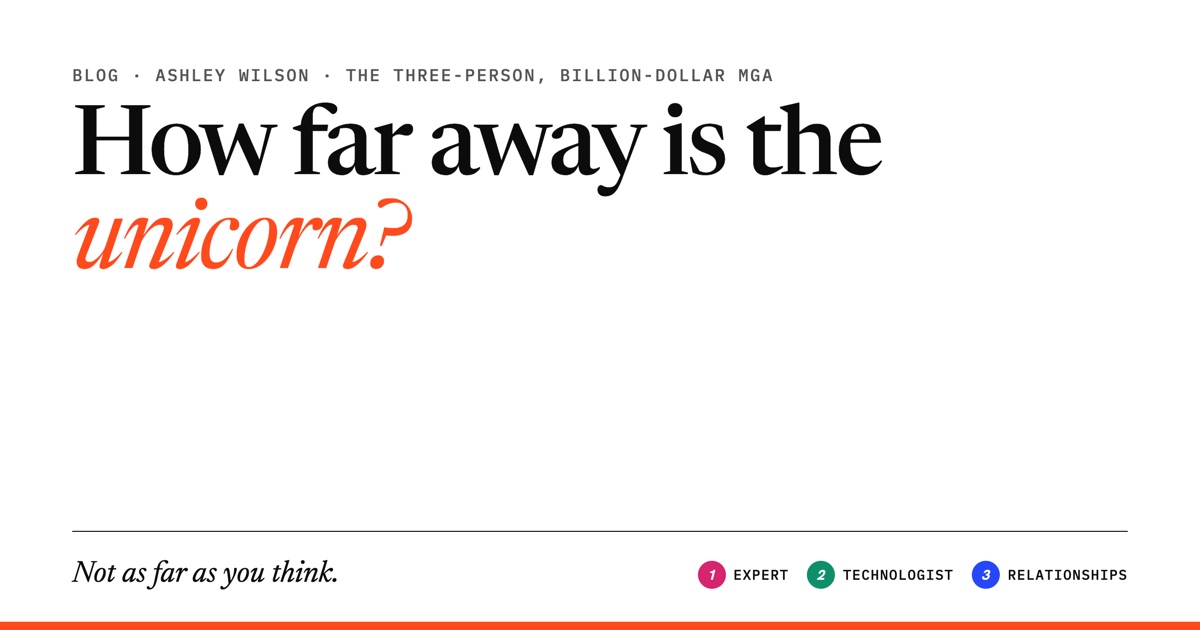
Building the three-person, billion-dollar MGA
C'mon. There's something alluring about being "the one." The one who can solve it with less, and go farther.
That's the whole game. VCs lose on deal after deal to find that one. Founders and startup builders lose, and lose, and lose, believing in the next thing. Hell, I've had as much private equity end up worth only the paper it was printed on as anyone else out there playing the game of startup roulette.
So when we study the AI billionaire moment, and all the talk about the first tiny team to build a billion-dollar company, I don't roll my eyes. I start asking where it could actually happen.
My answer: yes, an MGA is coming within reach.
First, what's an MGA?
A managing general agent (MGA) is an insurance business that a carrier trusts to write policies on its behalf. The carrier puts up the capital and holds the risk. The MGA designs the program, prices it, sells it through agents, underwrites it and services it, and earns a share of the premium.
Think of it as an insurance company's brain and hands, without the insurance company's balance sheet.
Why the model could work
- It's light on capital. The MGA doesn't carry the risk on its own books. That's the carrier's job, and the reinsurers' behind it.
- The work is information work. Rating, quoting, underwriting rules, policy documents, reports to the carrier, regulatory filings. Most of it is reading, sorting, checking and writing, which is exactly where AI got good, fast.
- Revenue grows with premium, not headcount. In the old model, more policies meant more people. With AI taking the first pass on most of the work, a small team can carry a book that used to need a floor full of people.
- Speed is the edge. A small team that can stand up a new program quickly can fill the gaps the big players are too slow to see.
I've been prototyping the launch side of this. Groundwork, on my portfolio, takes a line of business and a state and lays out a prototype rater, a go-to-market plan, a regulatory path, a capital plan and a launch kit. It's a demo, not a live MGA, but it shows how much of the setup work AI can carry.
What it will really take
Not a big team. Three people. And honestly, these three:
- A badass expert who has been inside the business and knows it soup to nuts. Underwriting, distribution, claims, compliance. The person who knows which risks to write, which to walk away from, and why the last program failed.
- A flexible technologist who loves the work. Not someone who builds one system and moves on. Someone who keeps rebuilding as the tools change every few months, and enjoys it.
- The indispensable person who can manage the relationships. Carriers, reinsurers, agents, regulators. Insurance still runs on trust, and trust still runs on people.
That's the recipe that breaks through. Not because it's easy, but because these three core functions must persist. AI can take on more and more of the work around them. It can't replace judgment earned inside the business, the drive to keep building, or a carrier who picks up the phone because they know you.
So how far away is the unicorn?
Not as far as you think.
The odds didn't change. Startup roulette is still startup roulette. What changed is what it takes to sit down at the table. The team is smaller, the tools are cheaper, and the work that used to need a building can run on three people who are very good at what they do.
If you're one of those three, and you're looking for the other two, I'd love to talk.
Thank you. I read every one.
Want to talk about it in public?
Join the conversation on LinkedIn ↗